

Fletch Answers Salary & Forecaster Questions
Send your questions to Fletch here. You will get a personal reply. Any topics posted here are made anonymous regarding people, location or church.
Salary Articles
Pastors, Directors & the Ministerial Exception
Cost of Living—especially in high housing areas
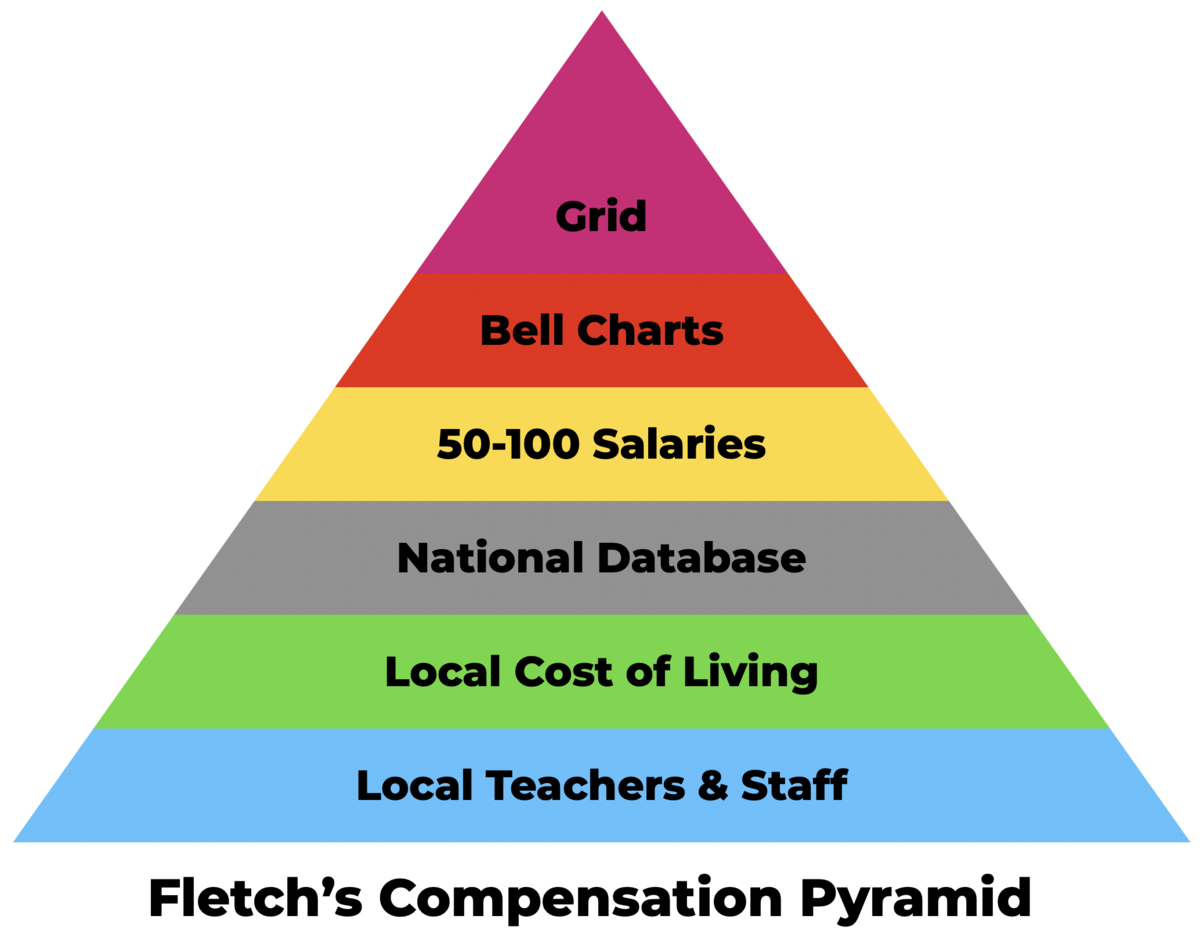
Learn how to use Fletch’s Compensation Pyramid
Salary Questions
For highly compensated employees, does the salary line include only salary over $150,000 or are benefits included?
The IRS defines a highly compensated employee as earning over $150,000. You can read IRS Notice 2022-55. It is a real slog to get through, as it is pretty technical reading.
Investopedia says:
If you receive compensation in 2024 that’s more than $155,000 and you’re in the top 20% of employees as ranked by compensation, your employer can classify you as a highly compensated employee. Compensation includes overtime, bonuses, commissions, and salary deferrals made toward cafeteria plans and 401(k)s.
The salary line in the Forecaster includes salary without benefits.
As of the day that I’m writing this, in the Salary Forecaster data, the average salary for a Senior Pastor is $152,284. That is based on over 900 churches, with an average of $3,317,248 in General Fund budgets. Ergo, there are many highly compensated staff in churches!
It is a best practice to get well-respected salary comparisons for highly compensated employees. Many boards prefer for an independent person to create the report, that is, not a staff person. I help a goodly number of churches who have boards that want an independent opinion.
I see that the salary amount may increase to $55,000. Is this something that is slated to happen on a specific date?
The current salary definitions to be considered as managerially exempt is directors meeting the FLSA criteria and a salary of $35,568 (more in certain states). A Texas federal judge revoked the increase of July 1, 2024 and the one planned for January 1, 2025. The federal level stays at $35,568.
This salary base also applies to Executive Assistants who meet the Department of Labor guidelines. I get into this with a full Compensation Analysis. It is deep but not too complicated once you understand the rules.
Exempt employees do not have to turn in a time card, record meal and rest breaks or be paid overtime.
All non-exempt employees must follow those rules. No exceptions. So if you call your Administrative Assistant after hours, he or she should be noting the time!
I am under the impression that there is a difference between ministerially exempt for FSLA and the IRS requirement for SECA pay and housing allowance. Is this not correct? Licensed or ordained pastors pay SECA but you can exempt a Children’s director or Worship Leader that teaches religious topics as a ministerially exempt, but those individuals are not licensed or ordained.
This is a wonderfully technical question. The rules say someone has to be licensed, commissioned or ordained to be ministerially exempt.
There is a wrinkle for ministry people as you have described. Courts have widened this for certain jurisdictions. The details of it are long and tangled. The safest route is to commission all ministerial workers, giving them a housing allowance. I get into those issues in a full Compensation Analysis.
What is your opinion on transparency of compensation within congregations?
There are really two questions here, one for the congregation and another for the state.
For the congregational question, many smaller churches, especially those with congregational governance, post the salaries of all their workers. As a church grows in size, this generally goes away.
For the state question, about 20 states now ban asking for salary data in the hiring process. Seven states now require pay transparency in the hiring process or to existing staff. This means that churches in those states must tell the salary range in the job posting.
I have mixed feelings on this. One of the causes for these laws was that women were often paid about 10% less than men. I’m a huge fan of paying women the same amount that a man would make in a given position—and over the years have raised many women who were underpaid to their fair levels. My preference that churches would be excluded from these laws, as it could be a poor inroad to the separation of church and state. Pay people based on their work, not their gender or being a friend of yours.
As one person wrote to me, and was agreed upon by another from California: “In New York City you now have to post salary range for any position you advertise for. This makes salary range info public and can potentially make existing staff think they are underpaid.”
Why do you utilize teacher compensation data for comparison data? I don’t necessarily believe they are compensated very well on average.
Some folks don’t think teachers are paid a fair and living wage. During the recent webinar, one person looked up teachers in their local school district. The comment back to me was, Okay, now I get it. They are paid just about like our pastors.
I like school district pay scales as they are locally negotiated. They reflect local values and pay scales. And I’ve never had a congregant complain that our staff was paid about the same as local teachers. It’s a good talking point without ever going into the dollars and cents.
Let me add that top staff in many churches earn salaries that are comparable to district officials.
Finally, pastors can utilize the ministerial housing allowance to offset federal income taxes, while teachers tend to have better retirement plans in place.
When I do a compensation study or analysis, I like to see what the local school district pays. I am rarely disappointed in teacher or administrator salaries.
Does tenure affect salary in a significant way?
The length of time that upper level staff are in their positions does greatly affect compensation. This is especially true of senior pastors and founding pastors. There are churches of under 1,000 in worship that pay their SPs $150,000+, which is more than some in a church of 2,000 earn.
Is there a benefit to longevity in a pastor and should that be rewarded?
I would answer, yes. The longer that upper level staff are in place, the greater likelihood for a successful culture and sustainable growth. Remember the caveat: “your mileage may vary!” In other words, your results may be different.
The thing to consider is the old adage about the school teacher. The teacher said, I have taught for 28 years and haven’t gotten much of a raise. The Principal said, yes you have been teaching the same thing for 28 years, but you never grew. Being a live-long learner is what it is all about.
Our church does a 10% contribution to Pastor’s 403b accounts and 5% for non-pastors. Should we consider these as part of their cash compensation in the comparison to the quads and data you provide in a Compensation Study?
Those are some very nice benefits. I commend the church for such a generous retirement policy.
The simple answer to your question is “no.” The quads are based on salaries, not on total pay packages. The quads tell you how your salaries are in comparison to other churches.
The complex answer is “yes.” Each church should look at total compensation to determine raises. For example, one church gave a 17% FICA-type bonus to offset the cost of SECA. That is high for such a bonus—what a great deal for those pastors in retirement! That church asked a similar question as yours. With regard to raises, churches should look at their total benefits package. Yours may be high in retirement, fair in medical, and medium in a FICA-type bonus. This might cause you to say, “Staff member A is in Quad 2, but we will work slowly to get him or her into Quad 3.”
The beauty of the Quads is that they give you flexibility based on: the benefits package, scope of ministry, education, experience, alignment with church vision, being a team player, effectiveness, and other church values.
Forecaster Questions
Why do you use the budget as a determinant for salary size versus how many people come on Sunday?
This is a data driven answer. As you review the Salary Forecaster, you will find that churches with similar worship sizes often have huge variances in what they pay for upper level staff. I’m just following the data analysis with my preference to say that budget is a bigger factor in salaries then worship attendance.
Would the Forecaster be flexible enough to use if we are a church with a school and early education center?
The Salary Forecaster only lists church staff positions. It does not contain data on principals, teachers or other school employees. You will be able to get great data on church positions.
If my church has a Christian School, should I include their revenue in our church’s budget? Our church has a budget of $2.7 million and our school $2.0 million.
If the school is integrated into the church, the answer is yes. By that, I mean if the church is the one who processes payroll, and ultimately oversees HR, hiring and terminations. Your finance team is cutting those checks and processing payments, so it should be included.
The salaries shown here seem fairly higher than what I’ve seen on the Forecaster when I looked this past December. Do you agree? Why do you think that is?
It would take some time and digging to prove or disprove that. In general upper level salaries can be very healthy in churches with a wide variety of budget and worship sizes. When the economy is healthy, salaries go up.
The Forecaster is indexed for inflation, so this year’s salaries reflect the anticipated inflation for the year. The Forecaster is just that, a forecaster for the coming year. That inflation number is finalized in the Forecaster when the Social Security Cost of Living Adjustment (COLA) is announced.
With years of data reviewed, churches over a five to seven year period match Social Security COLA to a tenth of a percent in total salary increases.
What defines Quads 1 through 4?
If you do a Compensation Study, such as with XPastor, Salary Quads 1 through 4 are created. The Finance Committee, Compensation Committee, or Board has the final decision for salaries in each quad.
As to what defines those quads, they should represent minimum to maximum pay for the respective staffing tiers.
The quads are based on the Standard Deviation for a given dataset. When I do a compensation study, I provide the standard deviation numbers, percentiles, bell curve charts, suggested quads and list the 50-100 detailed salaries used.
I like quad 1 to be at the 10th percentile of the dataset and quad 4 to be at the 90th percentile. This eliminates the stray numbers at each end of the dataset. I smooth out the numbers into meaningful and evenly spaced norms.
Remember that staff rarely jump from one quad to another. Generally raises over several years take a person from one quad to another.
Does salary include housing?
Yes it does.
The ministerial housing allowance is a self-determined number by the pastor, approved by the church. Some churches list it separately in their budget numbers but it still considered a part of salary.
For SECA tax purposes, the pastor pays 15.3% on total salary, including housing and any bonuses.
Did your data include additional Senior Pastor perks? Car allowance? Housing?
Housing is not a perk. It is a number determined by the pastor from their total salary and submitted to the board for approval.
A FICA-type bonus that some churches give to offset the cost of self-employment tax is not included in the salary line. It is a bonus, not salary.
When I work with a church to create a total compensation worksheet, or “Big Burrito” as I like to call it, we look at all perks for every employee.
The numbers for the Salary Forecaster should include in one line all staff benefits, from those you mentioned, plus medical, insurance, life insurance, car, cell phone, retirement, etc.
When you fill out the data form for the Salary Forecaster, you will see separate lines for annual budget, payroll budget and benefits budget. We don’t ask for benefits for each position, mostly because the majority of people won’t take the time to fill it in. Knowing the total benefits number, you can then find the percentage of benefits to general fund budget, and that gives plenty of good data.
How many churches have responded so far to the surveys?
The Salary Forecaster has billions of dollars in church budgets from hundreds of churches, with thousands of roles listed.
Some other data sources may have more churches, the Forecaster gives you access to most salaries in each church, thousands of line items. You can compare all of them in a way that you would in your own budget process.
The Forecaster database is sufficiently large so as to be statistically accurate. It provides meaningful data.
When you say worship size are you referring to the number of people in your primary worship service or the number of people in the building at worship time? Our worship is for 6th grade through adult. Below 6th grade has their own programming.
Counting worship attendance varies a great deal.
The salary data form for the Forecaster asks for, “Average # in weekly worship.”
Everyone has their own formula, some including online attendance. The preference to count all those in weekly worship, which in your case would include 6th grade and above.
The Forecaster includes part time and full time salaries. For example:
- Video Producer—$18,722 for a church of 700 in the Midwest
The Forecaster is a snapshot of amounts paid. Include the actual wages paid, not an annualized amount for part timers.
It is easy to see where the full timer salaries begin:
- Video Producer—$18,722 for a church of 700 in the Midwest
- Video Producer—$24,962 for a church of 200 in the Northeast
- Video Producer—$49,800 for a church of 900 in the South
- Video Producer—$54,212 for a church of 900 in the South
Why doesn’t the Forecaster show part-time hours? There are two reasons for this. One is that it could hurt the anonymity of the public information. Someone could in the off chance correlate part-timers with a specific budget and try to get the salaries for a particular church. The other is that inputting the data at that level would make less people send in their info. Perhaps in the future!
Fletch … If possible, I think it would be helpful to have salaries in the Forecaster annualized (rather than calculating based on hourly rate and hours worked per week). I say this because one position at our church might be 30 hours per week, but the same position at another church might only work 20 hours per week. With annualized salaries listed, it would make it easier for us to calculate per hour rates based on the traditional 2,080 hours per year, which would help us feel more peace of mind that we’re paying our employees fairly on an hourly basis. Thank you for listening to my feedback!
That is something that I have wrestled with! You have a great point. I designed the Forecaster to show a “slice in time.” All the salaries are what is paid for a given church, top to bottom. This allows people to get a sense of the scope of salaries in a church. For example, one church may have ten part-time Administrative Assistants and another with only two. Seeing that difference tells a great deal about the hiring philosophy in churches of similar budget ranges.
Here is what I would suggest. For a position, such as an Administrative Assistant, only look at the salaries that are over a threshold, say $28,000 for that role. In May of 2026 we had 1,433 Administrative Assistant roles listed. Of those, 882 were paid over $28,000. This gives you a great starting place for comparison.
Thanks for the input. It is always welcome.
Some churches, especially mega churches (2,000 or more in worship) and über-mega churches (over 5,000 in worship), put all staff in the Forecaster in certain generically titled roles, such as “Facility Staff.”
- Facility Staff—$573,669 for a church of 10,000 in the Midwest.
- Facility Staff—$272,024 for a church of 1,100 in the South.
- Facility Staff—$108,425 for a church of 1,000 in the West.
For all other positions, please put one person per line. Add extra lines, for example, for multiple campus pastors, especially if they earn different rates.
For the über-mega churches with over 10,000 in worship. The Forecaster lists them as 10,000 in worship.
This is done to protect the anonymity of the church. There are about 115 of these churches in the United States. It would be too easy to identify a church if the specific size was listed, such as 21,225 in worship.
Fletch … I am sorry but I do not presently have access to the salary data. However, I am trying to lean forward into the tasks set before me to demonstrate my knowledge and understanding of church operations.
It is fantastic to want to grow in this area! Salaries and benefits are on average 54% of a church budget, so get your arms around them.
Here is what you can do:
- Ask the Business Office, CFO or Treasurer to send the Forecaster Data Sheet directly to me, not copying you on it.
- Ask them to note in the email or file that you are also wanting access to the Forecaster.
- You will be granted access to the Forecaster, while never seeing your own church’s data. All of our data is anonymous by the 4 US Census regions, 57 titles and other methods that we use.
The benefit is that the church will have access to the data for salary comparisons, and so will you!