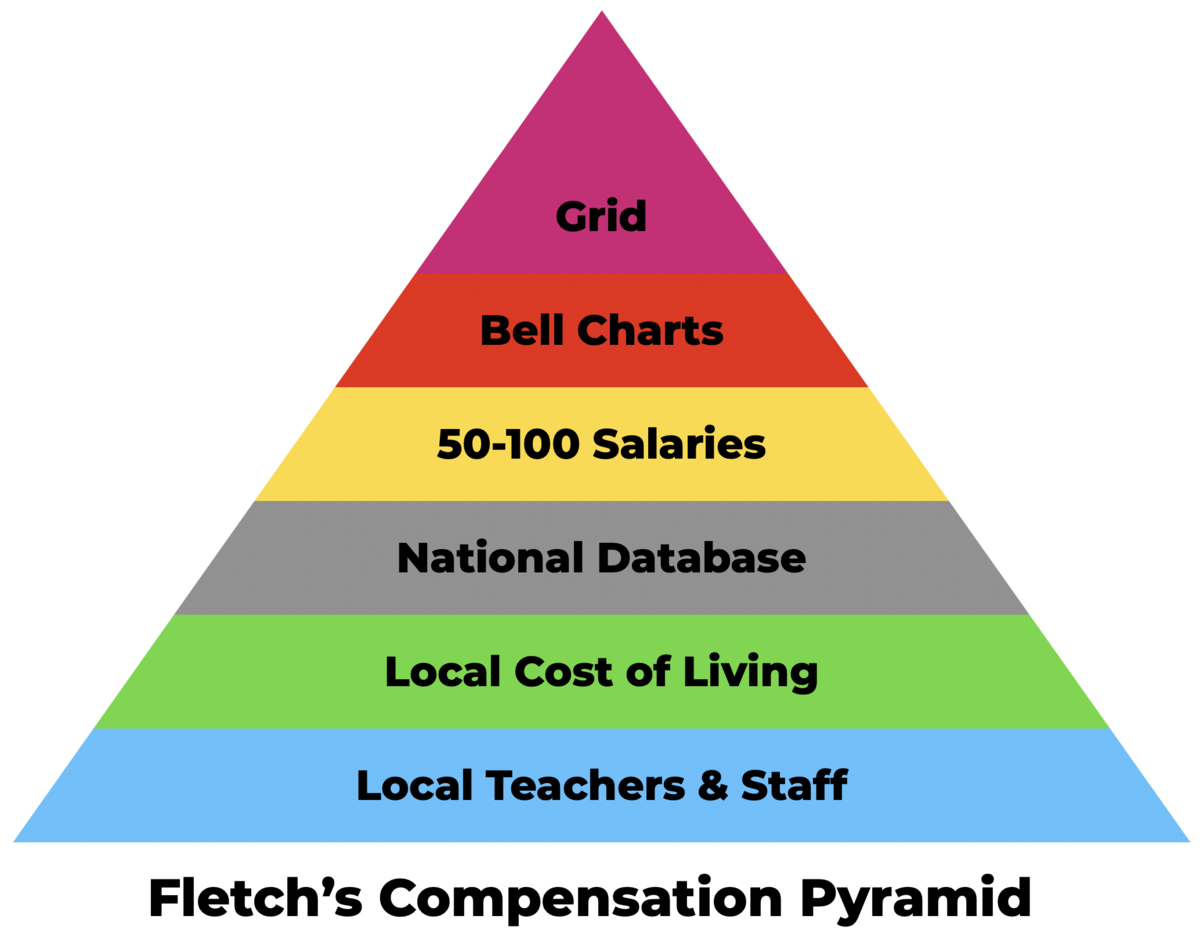
An excellent Compensation Study needs methodology. I developed the XPastor Compensation Pyramid to provide rock solid methodology.
Just as I use the pyramid in XPastor Compensation Studies I perform for various congregations, churches around the country also use it in their own DIY studies.
My regret is that I didn’t develop this comprehensive system years ago when I was an Executive Pastor.
Local Schools
The base of the pyramid is local schools. Why use teachers as a base? Walmart has 1,600,000 employees and Amazon has 1,100,000. There are 3,400,000 public school teachers nationwide, larger than Walmart and Amazon combined. Those who negotiate teacher contracts take into account factors for local pay and national teacher wages.
Most local school districts publish their full salary schedules. This provides insight into your community’s local teachers and district staff. You get the benefit of your school district’s negotiations in a highly readable format.
For example, in a recent XPastor Compensation Study, I found the local school district started a new teacher at $50,999 and the most experienced teacher capped out at $119,056. That district had 27 steps between the minimum and maximum, and they included educational tiers from Bachelors to Doctorate. The district staff earned from $95,260 for a Supervisor to $200,000 for the Superintendent. As a rule, the majority of pastors are paid similarly to a High School Teacher. Executive and Senior Pastors, as well as some upper level staff, are paid akin to a High School Assistant Principal, Principal or district staff.

Thus, your local school district is an excellent source of hard data for the base of the pyramid.
Local Cost of Living
Do you know how much it costs to live in your community?
Some churches pay their Pastors at a level that requires both husband and wife to have full-time employment.
The majority of churches pay their Pastors so that one parent can stay at home with their children.
Which church do you want to be?
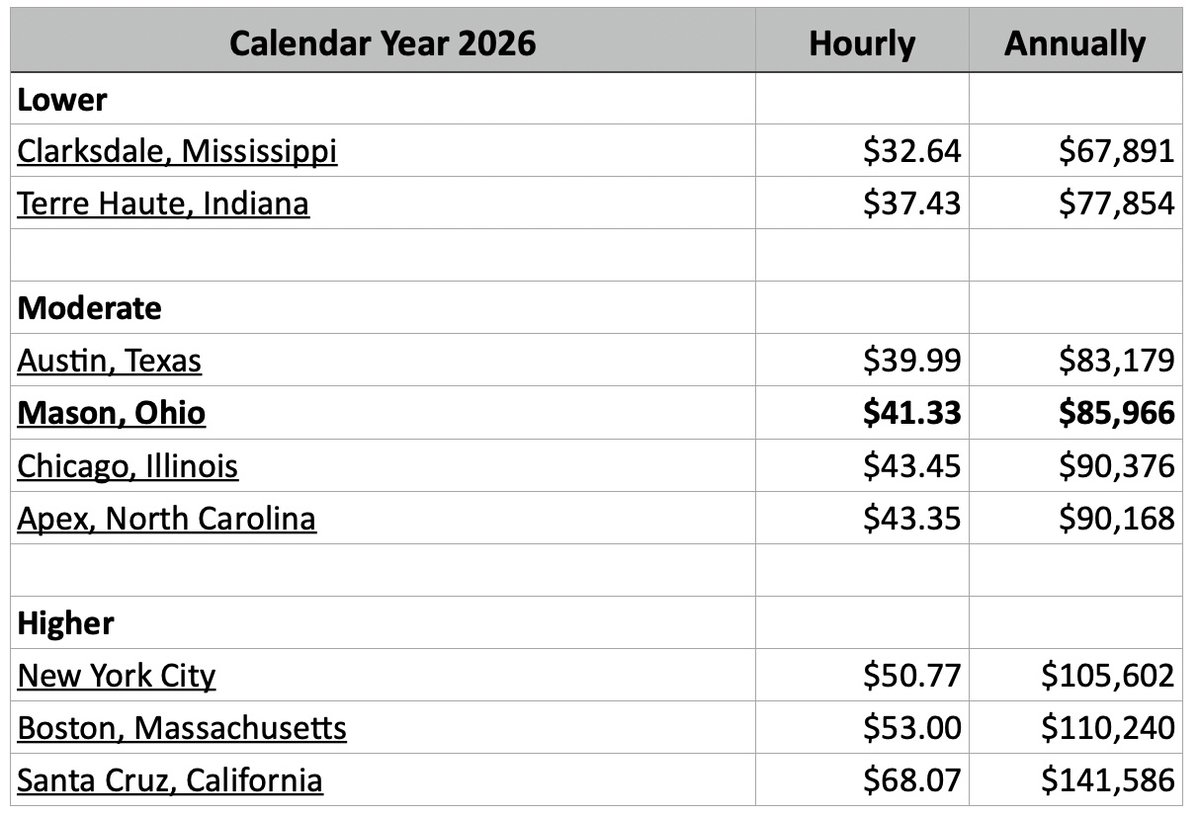
Getting local cost of living data is easy. Dr. Amy K. Glasmeier and the Massachusetts Institute of Technology created the Living Wage Calculator.
The calculator includes living wage estimates for 3,144 counties to account for the geographic variation in costs across the U.S. The data is also available for 387 Metropolitan Statistical Areas and 50 states.
The lowest cost of living area that I have found in 2026 is Clarksdale, Mississippi at $67,891 and the highest is Santa Cruz, California at $141,586.
It should be noted that the highest church wages tend to be in the South. Thus a high cost of living does not necessarily translate to higher church wages. That is what $3.8 billion church data in the XPastor Salary Forecaster presents, not my opinion or preference. The main determinate in church wages is the size of the budget. So some well-funded churches in high cost of living areas do pay more, while less funded churches do not.
The local cost of living data gives you a reference point to compare to teacher salaries. The starting teacher with a salary of $50,999 will need a two income household to raise children, while a upper end teacher at $119,056 can live in a one or two income household.
National Database
There are several church salary databases available for use with your credit card. Of course, my favorite is the free XPastor Salary Forecaster. The billions in church salaries give solid data points for 57 church roles. And, did you read that word free? Submit your data and receive access to the Salary Forecaster.
As an Executive Pastor, I designed the XPastor Salary Forecaster as one who sets salaries and budgets. I like to see the range of salaries in a church, from the Senior Pastor to the facilities worker. The range gives you perspective. Some churches use differing titles, some churches have a very large gap between the Senior Pastor and the next staff person. The Forecaster shows most, if not all, of the positions in every church. With anonymized data and the four US Census Regions, you can’t pinpoint a specific church, but can see their salaries, budget and worship size.
The national database you use should give a range of specific salaries for your compensation study, along with providing church worship size and budget. This gives you realistic data for your size church, whether it be 100 people or over 10,000.
Similar Salaries
The key to an effective compensation study is finding 50 to 100 salaries for selected positions. The XPastor Salary Forecaster may be the only database that gives all the salary data points.
It takes time to pour through the church data in the XPastor Salary Forecaster. The church data gives the details for every church—positions, salaries, budget, census area location, and worship size.
You can find many churches in your region with a similar budget size. At a granular level, learn how other churches are paying their staff.
It take some time, though, for a thorough analysis.
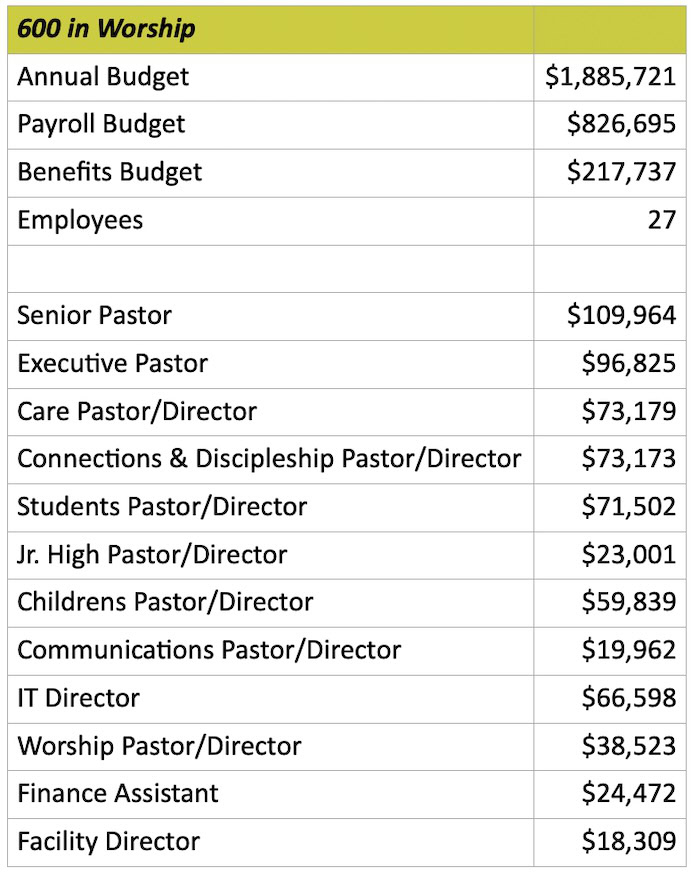
By downloading to your computer the XPastor Forecaster’s Pivot Tables, you can see everything for 57 positions, except the budget size.
This gives great insight into the ranges of salaries in various Census Regions.
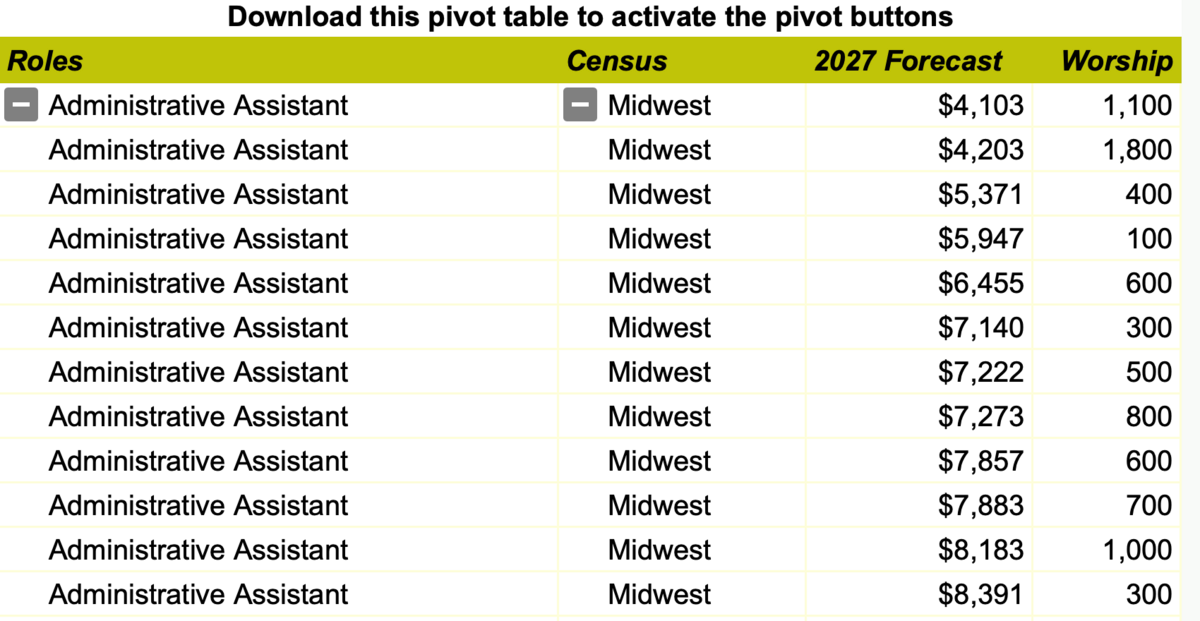
You probably want to do a deep dive for only selected positions. For example in my XPastor Compensation Studies, you would receive a comparison of five staff salaries with 50-100 salaries and budget data points—more can be added and many churches do that. For many staff positions, using the a rough guide from the Pivot Tables is sufficient.
Analytics and Bell Charts
The gold standard for a compensation study are Analytics and Bell Charts. They are based on the 50-100 salaries that you selected.
Analytics provide statistics that you need for a position: average of all selected salaries, the percentile rank (such as 40th percentile, meaning that 39 salaries are below the person and 59 above), the minimum and maximum in the range, and the 10th to 90th percentiles.
The 10th and 90th percentiles are hugely important. They set the minimum and maximum amount in the Compensation Grid—see below for that.
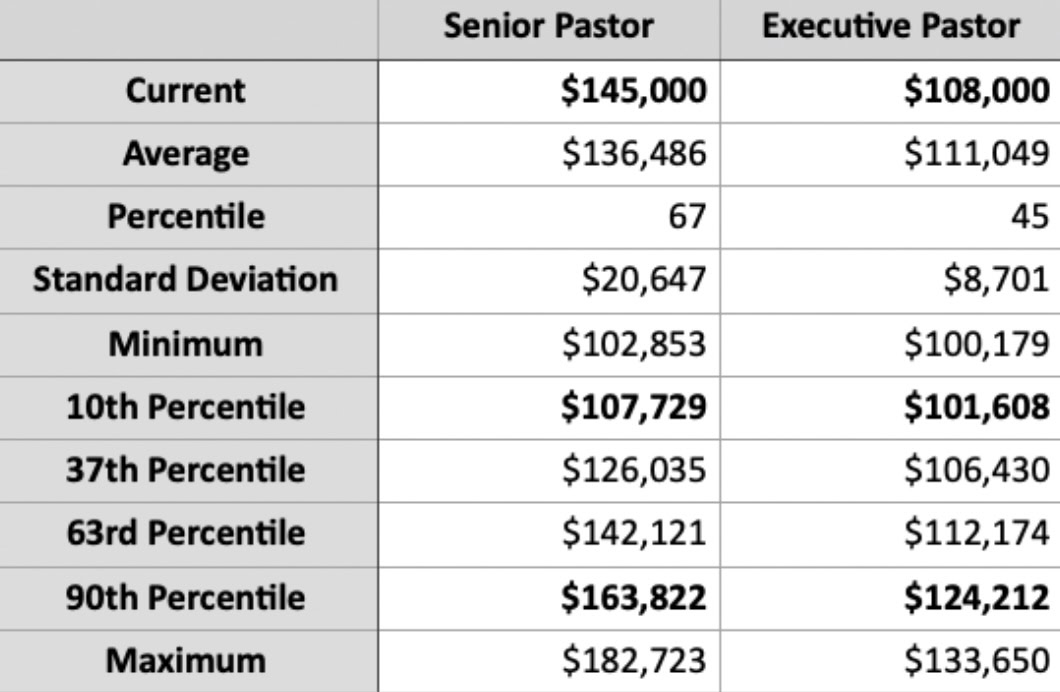
From the data, create a Bell Chart. This is pure gold. CPAs and mathematicians can interpret the Analytics. A Bell Chart provides the data in a visual format that everyone can understand. Be sure to activate the dots to represent every salary selected. This shows on the chart where the salaries lie.
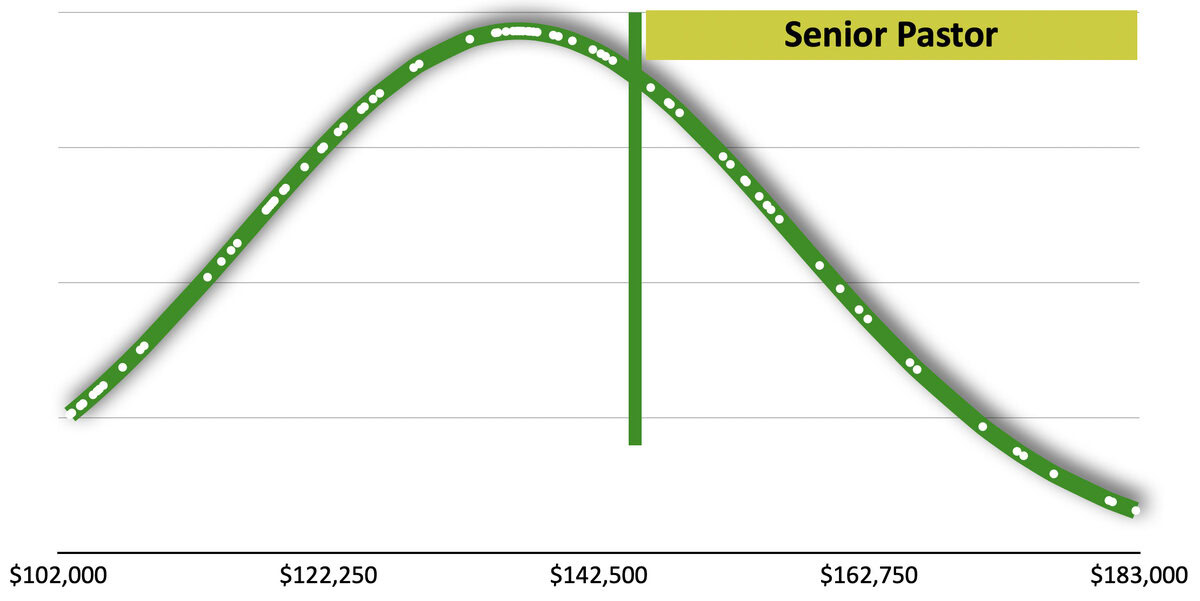
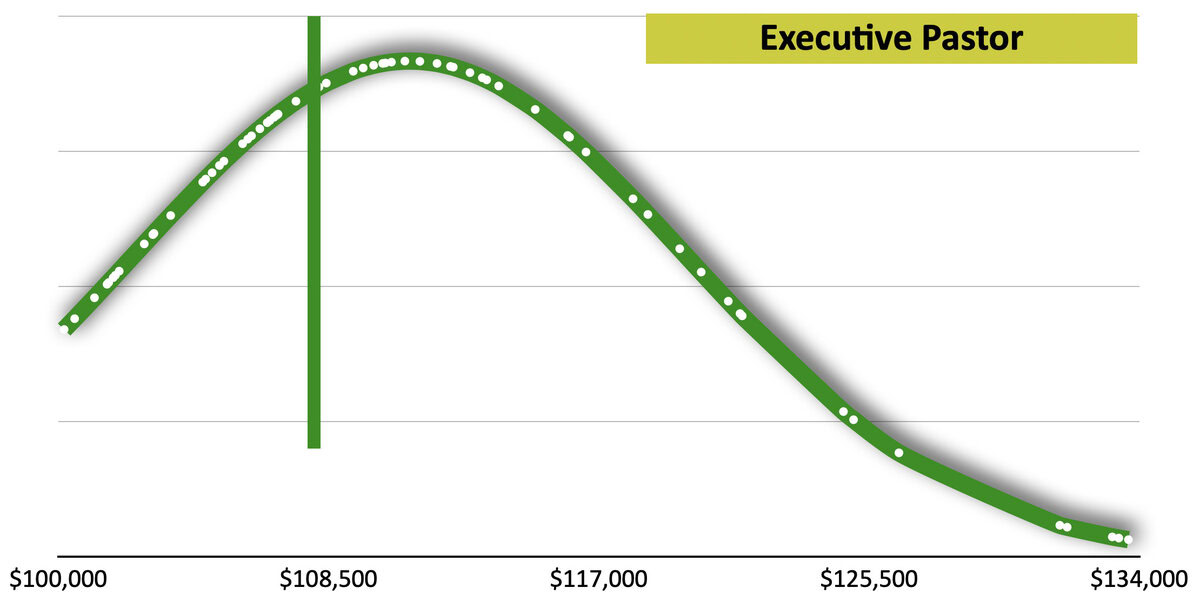
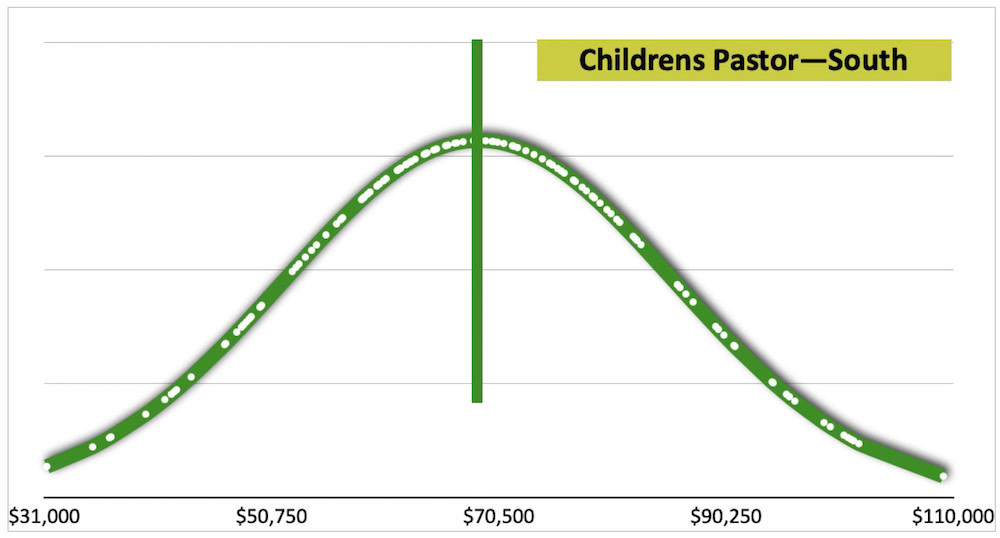
While it is a fair amount of work to create the Analytics and Bell Charts, they give the statistical data necessary for an excellent compensation study.
Compensation Grid
The top of the Pyramid is the Compensation Grid. You have local school district data, the local cost of living, a national database, 50-100 salaries, and your Analytics and Bell Chart. Now it is time to make the Compensation Grid.
To create a Compensation Grid, start with the Analytics for selected staff. The 10th percentile is quad 1 and the 90th percentile is quad 4. Data below the 10th and above the 90th are dropped as they are the tails and give less significant data. I like 4 quads, rounding the numbers between the 10th and 90th percentiles to give easy to read salary ranges.
Then, use data from the Pivot Tables, or local market data for many support staff, to create the rest of your Compensation Grid.
You may have good evidence for starting a Pastor in quad 1 or see that the person is underpaid and needs a raise. Raises from one quad to the next often take one to three years, but sometimes an immediate quad change is needed. You don’t want to lose a staff member because another church offers a higher salary.
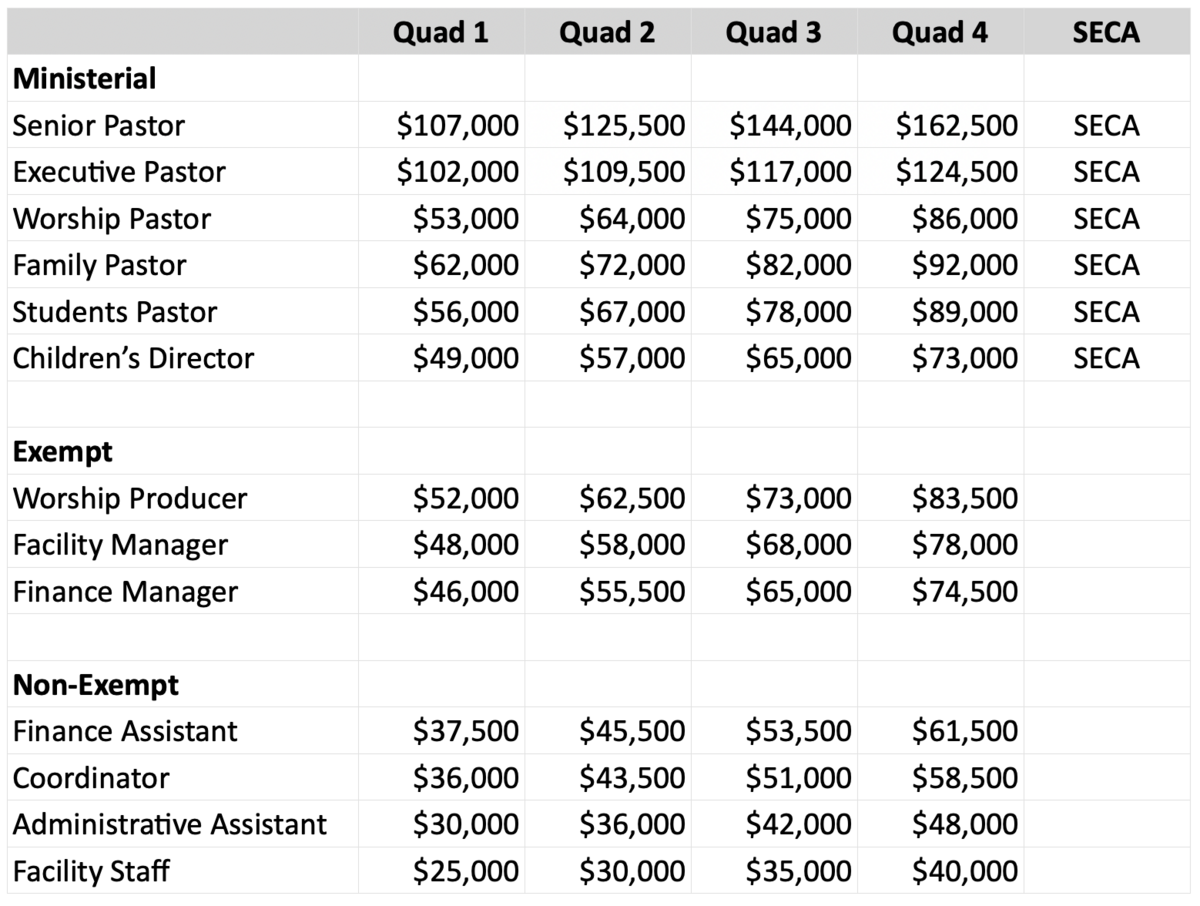
A Compensation Grid should be valid for three years. After that, it is necessary to go through the Pyramid process again.
Conclusion
By using the XPastor Salary Pyramid, you can produce a rock solid compensation study. Be prepared to invest a significant amount of time to create your magnum opus. My XPastor Compensation Studies regularly run from 30 to 95 pages. That is why many churches have XPastor produce a Compensation Report. However, you can do it on your own with reliable data!
An outsider doing a Compensation Study doesn’t have “a dog in the hunt.” They are independent and objective. That, and the rock-solid data and analytics, are key reasons why churches use XPastor for their studies.
With a solid compensation study, church leaders are ready for a vibrant and data-driven discussion. Gone are the days of meetings where members say, Well I don’t know or Is that a good number. One Elder in a church in the Southwest said about the XPastor Compensation Study:
The compensation discussion was succinct, data based, and meaningful. The best part is that we quickly gained agreement and left the meeting confident that we had made the right decision. In the past, compensation discussions were often lengthy, filled with opinions rather than data, and not characterized by confidence.
XPastor provides this information so that you can pay your staff a living wage, one that is in keeping with other churches of your size. Our goal is that all pastors are paid a fair salary that fits in with your local community.
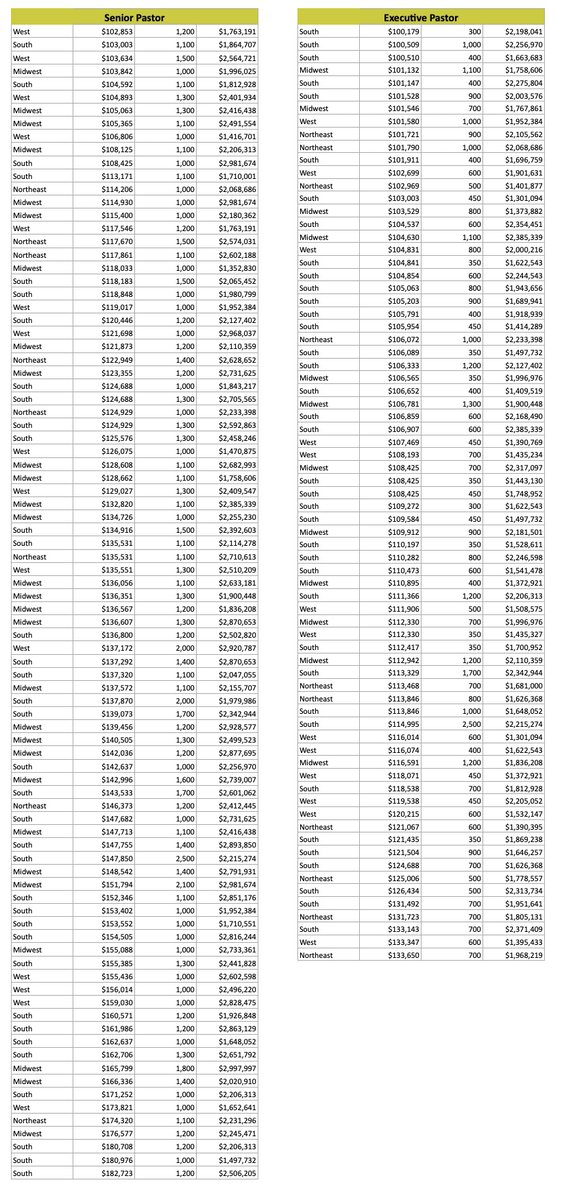
Appendix—Sample of Salaries