
Something Has Changed
The year was 2004, and my wife and I were filling out paperwork to take home our very first cell phone. The helpful assistant asked if we wanted to add texting to our plan by purchasing a certain number of texts per month. We laughed a little as we couldn’t imagine a world where taking the time to use the numeric keypad to send texts awkwardly would ever be faster than a 30-second phone call.
Fast forward to today, and things have changed. Last week I was waiting to pick my son up from school and sent him at least 5 texts letting him know I was waiting outside before I ever considered the option of—gasp—making a call.
It’s amazing how our use of technology changes over time. I recently realized another drastic change in my use of technology, and this one has major implications for the church.
AI and Your Church Website
I now use AI every single day. I ask questions, brainstorm, and work out potential solutions using LLMs like ChatGPT, Claude, and Google’s Gemini. I almost never search on Google anymore. But when I do, I’m quickly reminded why I seldom go there now.
On ChatGPT, my questions are conversations where I can work with the model to nail down the true intent of my question in order to determine the ideal answer. On Google, my searches result in a bunch of links where I have to first determine if the links are relevant, trustworthy, and helpful. I’ll then have to go to each site to try to find the actual answer to my question. UGH—so much clicking, searching, and reading for often simple questions! AI has obviously changed me.
Then, the other day I was thinking about a local church and wondered about their youth program. So, I went to their site and found myself staring at the home screen. How was I going to get my question answered? The thought of searching their menu system for youth, then reading all the words and maybe having to watch a video, just to get my simple question answered seemed annoying. I actually considered going back to ChatGPT and asking about the church’s youth program in hopes that it knew the answer. To be honest, after living with AI every day, going to a church’s website felt like going back in time.
The Growth of Zero-Click Searches
Apparently, it’s not just me. How humans interact with the internet is changing before our eyes. Over the last few years, traditional search clicks have decreased by anywhere from 20-42%, while zero-click results—people finding answers directly on the page without ever clicking through—have increased by 65%.
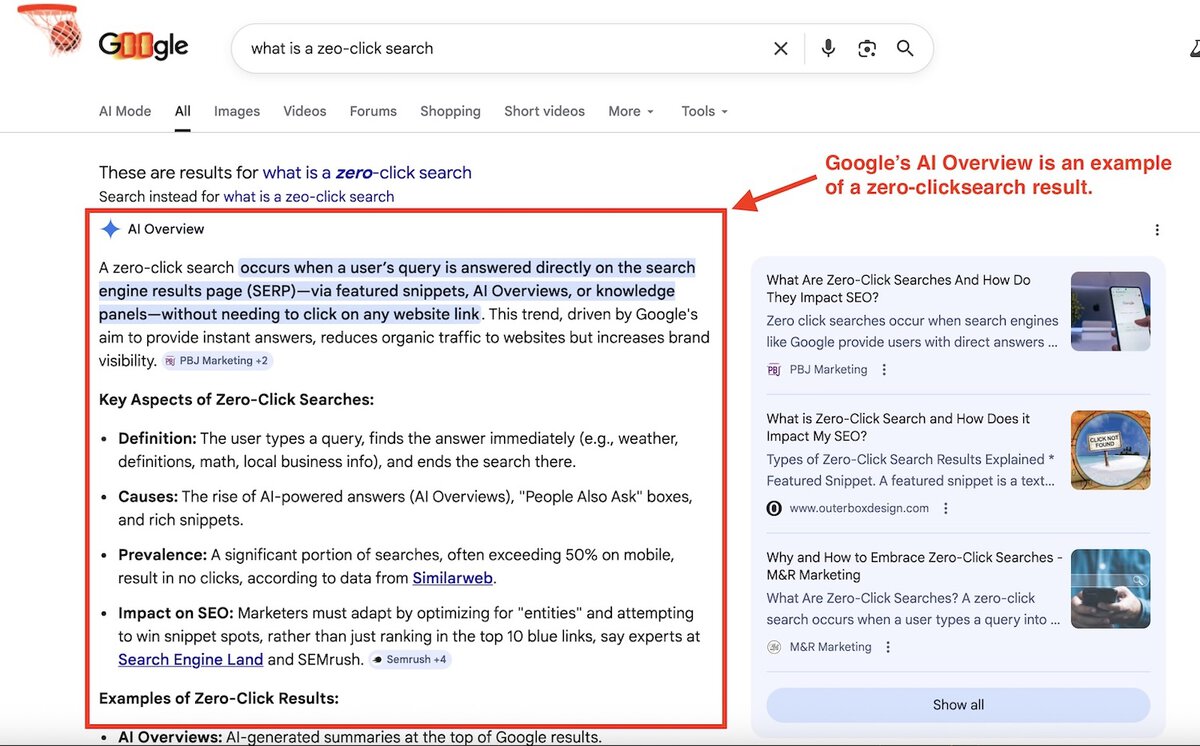
These numbers paint the picture of a dramatic change in how humans are interacting with online content. For years, the main goal of a church website was to do everything it could to rank high in a Google search result, in order to earn a click on the site. Now, a church has to do everything it can to be found by AI search while offering content that is ready to answer all questions users have in the moment, without a click to your church website.
Zero-Click Searches Impact Churches in Two Ways
1. Churches need to improve their presence in AI search
For years, website advocates have been encouraging churches to work on their SEO—search engine optimization. Getting right with Google, as some have called it. Churches that invested in this became more easily found by people searching for a local congregation.
But what’s needed now goes beyond SEO. Churches need to think about how AI search engines prioritize content and learn to play by their rules. This is sometimes called GEO (generative engine optimization) or AEO (answer engine optimization). Instead of getting right with Google, churches today need to get right with AI in order to be found by local people searching for connection. This may mean asking a harder question: Is the website that helped your church grow up to this point the same website you need to help you grow into the future?
Multiple factors impact a church’s AI search rankings, but I’ll mention two. First, topical completeness—does your content offer a full answer to questions people are asking, with no need to go anywhere else? Second, topical freshness—AI search engines favor newer content. A church website that hasn’t been updated in two years isn’t just outdated. To an AI engine, it’s invisible. Keeping your FAQs current and maintaining an active blog aren’t optional anymore. They’re your church’s presence in the conversation people are already having.
2. Church websites need interaction in an AI world
Have you ever been driving 70 MPH on a highway and taken an exit onto a road where the speed limit is 25 MPH? When you’re used to moving faster, slowing down is genuinely hard. That’s what it feels like today to go from chatting with AI all day and then land on most church websites.
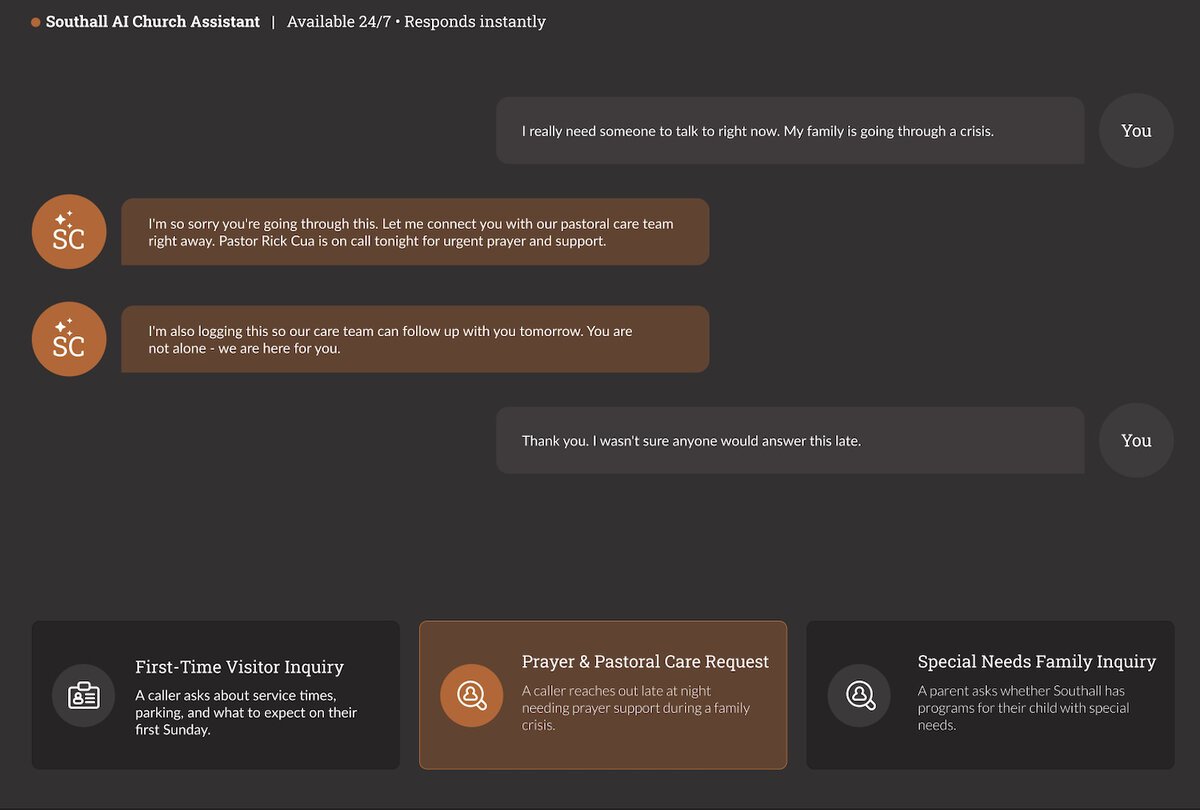
People want answers now. They want to chat, not scroll. In fact, the future church website may be primarily a conversation—a place where questions get answered in real time, 24 hours a day. For now, churches looking to give visitors the best experience need to offer a two-way AI chat function. Not a message form where someone hopes a human checks an app. A real, always-on, AI-powered conversation that can answer any question about your church at any hour.
The Birth of Agentic Features
Here’s where things get really interesting—and where the future is being built right now.
Imagine a website that learns and changes in response to the needs of local people searching for a church. Imagine what would happen if your church website were always listening to what people were asking, automatically creating AI-search-ready responses. Imagine a website that people could genuinely interact with or speak to, one that was connected to your church staff and ready to help people connect in ways you never thought possible.
This dream is becoming a reality today with agentic websites for churches and also agentic website features. Calling a website or a feature “agentic” is nothing more than a fancy way to say something is built with AI, so it has the power to learn about your church, in order to make decisions and take certain actions that it was trained to make. This means that if your church is thinking about building a new website, the questions you need to consider are changing.
4 Questions to Ask When Considering a New Church Website
If your church is considering a new website build, the old questions you’d ask a potential builder were about design and user experience. Those still matter. But a beautiful website that nobody finds, and that goes silent the moment your office closes, isn’t serving your mission.
Here are four better questions to ask:
- How do your church website builds ensure that your church will be found first in AI search results?
- Does your build include structured data and schema markup—and can you show me how that helps AI engines understand and present your church to searchers?
- Once your site is built, what is your ongoing content strategy to keep fresh and relevant in AI search?
- What agentic features do you offer that will ensure your website is future-proof so you won’t be asking about a new site in a few years?
The Future of Church Websites
When my wife and I got married, we couldn’t have imagined a world where people texted more than they called. But human behavior changes with new technology, and AI is changing our internet behavior at a pace none of us fully anticipated.
Here’s what I want to leave you with. Investing in being found in AI search isn’t primarily a technology decision—it’s a ministry decision. It’s an investment in evangelism. We are called to go where people are, and people today are increasingly searching for spiritual meaning on AI platforms.
What if you found out that every searching soul in your community was heading to the local coffee shop every Saturday morning to ask big questions about faith? What would you do? Would your church invest in a robust coffee budget to meet people right where they are?
Today, that coffee shop is ChatGPT. And the question every church must consider is whether Jesus—through your local church—will be ready to meet them right in the middle of their search.
